Best AI Courses After 12th: Your Honest, No-Fluff Guide
Introduction
You just cleared your 12th boards — or you’re about to — and everyone around you is suddenly an expert on what you should do next. ‘Go for engineering.’ ‘Do commerce.’ ‘Try law.’ But somewhere in all that noise, you’ve heard the words AI and machine learning thrown around like they’re magic. And honestly? You’re not wrong to pay attention.
AI is not a trend anymore. It’s reshaping jobs, industries, and honestly the entire economy. The question isn’t whether AI matters — it does — it’s whether you should get into it right after 12th, and if yes, how.
That’s exactly what this article is about. No vague career advice, no unnecessary hype. Just a practical look at the best ai courses after 12th, what they actually involve, who they’re best suited for, and what kind of future they can lead to. Whether you’re a science student, commerce student, or just someone who’s curious and wants to get in early — there’s probably a path here for you.
WhyAI Courses After 12th: ? Is It Even the Right Time?
Here’s the thing. Most people think AI is only for people who already have an engineering degree or a Masters. That’s just not true anymore.
The field has opened up massively. Platforms like Coursera, edX, and even YouTube have made the fundamentals accessible to anyone with a decent internet connection. Colleges in India and abroad now offer undergraduate programs in AI and machine learning. You don’t need a PhD to get started — you need direction.
Starting early also gives you a huge advantage. By the time your peers finish a general engineering degree, you could have two or three years of hands-on experience, a solid portfolio, and maybe even a few freelance projects under your belt. That kind of head start is genuinely hard to beat.
That said — don’t jump in blindly. AI requires patience. You’ll deal with math, statistics, and a fair bit of coding. If you hate all three, you might want to reconsider. But if you’re even mildly interested in how things work, how computers learn, and where technology is heading, then the timing actually makes a lot of sense.
Types of AI Courses After 12th — What Are Your Options?
There’s no single ‘correct’ path here. Different options work for different people depending on budget, time, and what they actually want to do. Let’s break it down.
1. Full-Time Degree Programs (B.Tech / B.Sc.)
This is the traditional route. A 3-4 year undergraduate program gives you structured learning, a recognized degree, and campus placements. If you want to work at top-tier companies eventually, a proper degree still opens more doors.
B.Tech in AI and Machine Learning, B.Sc. in Data Science, B.Sc. in Computer Science with AI electives — these are the main options. Some reputed colleges offering these include VIT Vellore, Manipal University, SRM, BITS Pilani (through their integrated programs), and a few newer IITs that have started AI-specific courses.
The catch? Fees can be significant. Private colleges for B.Tech in AI can range from ₹3 to 10 lakhs per year. For government colleges, it’s much lower — but competition is high. Entrance exams like JEE (for engineering) or CUET (for central universities) are usually required.
2. BCA with AI Specialization
Bachelor of Computer Applications — or BCA — is a 3-year program that’s slightly more accessible than B.Tech in terms of fees and eligibility. Many universities now offer BCA with a specialization in AI or data science.
It’s a solid choice if you want a technical degree without going the full engineering route. The job outcomes are decent, especially in development and tech support roles.
3. Diploma and Certificate Programs
1-2 year diploma programs in AI/ML exist from both government polytechnics and private institutes. These are cheaper, faster, and get you job-ready sooner. The downside is that they don’t carry the same weight as a degree in higher-level hiring rounds.
Online certificates from platforms like Coursera, Google, IBM, and Microsoft are genuinely worth it if you pair them with a real project. A certificate alone doesn’t land you a job. A certificate plus GitHub projects and a portfolio? That actually works.
4. Short-Term Online Courses (Free and Paid)
This is the most flexible option. Platforms like:
- Coursera — Andrew Ng’s Machine Learning course is practically legendary
- edX — MIT, Harvard, and others offer real AI courses here
- NPTEL — Free courses from IIT professors, surprisingly good
- Google’s free AI courses — excellent starting point
- fast.ai — Practical and beginner-friendly, highly recommended
These won’t replace a degree for corporate hiring, but they’re perfect for building skills while you’re pursuing a formal degree or figuring out if AI is even for you.
Eligibility — Who Can Actually Do These AI Courses?
Good news: the eligibility criteria are usually not as strict as people think.
For B.Tech in AI or CS, you typically need Physics, Chemistry, and Math (PCM) in 12th with at least 60%. Some colleges also need a qualifying JEE or their own entrance test.
For B.Sc. programs, science background helps but is sometimes not mandatory depending on the university.
For online courses? There’s almost no barrier. Anyone can start learning Python and AI fundamentals from scratch. You don’t even need to have studied science. Honest truth — if you’re motivated enough, you can go from zero to a working knowledge of machine learning in about 6 months just through online learning.
Commerce or Arts students — don’t count yourself out. Data analytics, AI in business, and AI ethics are areas where non-science backgrounds are actually valued.
What Will You Actually Learn in AI Courses After 12th?
This depends on the course type, but here’s a rough picture of what the learning journey looks like.
First few months: You’ll learn Python. It’s the primary language for AI. Not scary at all — honestly, it’s one of the more beginner-friendly languages out there.
After Python: Statistics and basic math — probability, linear algebra, calculus. This is where many people slow down. But you don’t need to be a math genius; you just need to understand the concepts well enough to apply them.
Then comes the actual machine learning stuff — algorithms like linear regression, decision trees, neural networks. You’ll understand how a computer ‘learns’ from data. It’s genuinely fascinating once it clicks.
Later stages involve tools like TensorFlow, PyTorch, and platforms like Google Colab. You’ll build actual projects — image classifiers, chatbots, recommendation systems.
The truth is, the best way to learn AI is by doing. Build something, break it, fix it, repeat. Every project you complete teaches you more than three textbooks ever could.
Quick Comparison: AI Course Options After 12th
| Course Type | Duration | Avg. Fees | Job Outcome |
| B.Tech in AI/ML | 4 years | ₹3–10 LPA | ML Engineer, Data Scientist |
| B.Sc. Data Science | 3 years | ₹1–5 LPA | Data Analyst, BI Analyst |
| Online Cert (Coursera) | 3–6 months | Free–₹30K | Entry-level, portfolio boost |
| BCA with AI electives | 3 years | ₹1–4 LPA | Developer, AI support roles |
| Diploma in AI/ML | 1–2 years | ₹50K–2 LPA | Tech support, Jr. Dev roles |
Best Colleges for AI Courses in India — A Realistic Look
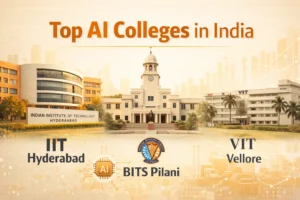
There are many colleges claiming to offer ‘AI courses,’ but the quality varies wildly. Here are some institutions that are genuinely worth considering:
- IIT Hyderabad — One of the first IITs with a dedicated AI department
- BITS Pilani — Integrated programs with strong industry connect
- VIT Vellore — Popular for AI/ML B.Tech, good placements
- SRM Institute of Technology — Emerging AI programs with decent infrastructure
- Amity University — Broad reach, AI programs at multiple campuses
- IIIT Hyderabad — Research-heavy, excellent for those interested in academia
ai courses after 12th
For government options, central universities under CUET and NITs with CS departments are also worth exploring. State engineering colleges with AI electives are improving too, especially in Maharashtra, Karnataka, and Tamil Nadu.
Don’t just go by rankings though. Look at placement records, faculty with actual AI research backgrounds, and what alumni are doing. Those things tell you more than any brochure.
Career Scope After Doing AI Courses After 12th
This is probably what you actually care about. So let’s be direct.
The job market for AI professionals is genuinely strong right now. And it’s only growing. According to multiple industry reports, AI-related jobs are expected to grow significantly through the 2030s. India especially is seeing massive demand as companies adopt AI tools and need people who understand themai courses after 12th
ai courses after 12th With a proper degree in AI or ML, you can target roles like:
- Machine Learning Engineer
- Data Scientist
- AI Research Associate
- Computer Vision Engineer
- NLP (Natural Language Processing) Engineer
- AI Product Manager (with experience)
Entry-level salaries for freshers with a B.Tech in AI hover between ₹4–8 LPA at most Indian companies. At product-based companies or startups with funding, it can go higher. Internationally, these numbers multiply significantly.ai courses after 12th
Even if you go the online certificate route and build a solid portfolio, you can realistically land roles in data analytics, AI support, or junior ML positions. It won’t happen overnight, but it does happen.
A Word from Someone Who’s Been There
“I started learning AI in my first year of B.Tech from a course on Coursera. By third year, I had three real projects on GitHub and an internship offer. The degree gave me structure, but the actual skills came from building things on my own. Don’t wait for college to teach you everything — that’s the biggest mistake I see students make.“
— Priya Nair, ML Engineer at a Bangalore-based AI startup (3 years of experience)
AI Courses After 12th
How to Get Started Right Now — Without Overthinking It
Here’s a simple path if you’re in 12th right now or just finished:
Step 1 — Start Python. Just start. Use free resources like Python.org tutorials or freeCodeCamp. Spend 30 minutes a day. That’s it.
Step 2 — Take one free intro AI course. Google’s ‘Introduction to Machine Learning’ or Andrew Ng’s course on Coursera (you can audit it for free). Don’t pay anything yet until you know you’re serious.
Step 3 — Build one small project. A movie recommendation system. A basic spam classifier. Anything. Put it on GitHub.
Step 4 — Decide on the formal education path based on your interest level and finances. If you’re hooked, go for a degree. If you’re still exploring, continue with online courses while studying something else.
That’s genuinely enough to get started. You don’t need to have everything figured out before you begin.
Ready to Take the Next Step?
If you’ve made it this far, you’re clearly serious about this. That’s a good sign.
Pick one thing from this article and do it today — whether it’s exploring a course page, downloading Python, or just watching an intro video. Big decisions feel less overwhelming when you start with something small.
AI Courses After 12th:
And if you want more guides like this on navigating AI education and careers, bookmark this site. We try to keep things honest and practical around here.
FAQs
Can I do AI courses after 12th without maths?
You can start learning the basics — especially through beginner-friendly online courses. But for a proper degree or advanced AI work, math (especially statistics and linear algebra) is genuinely necessary. The good news is you can learn that math alongside the course itself.
Is B.Tech AI better than B.Sc. Data Science after 12th?
Depends on what you want. B.Tech gives you an engineering degree with better placement networks at engineering companies. B.Sc. is shorter, often cheaper, and still leads to good analytical roles. Neither is universally ‘better.’
Can a commerce or arts student do AI courses after 12th?
Yes. Online courses have no strict eligibility. For formal degrees, some universities now offer data analytics or AI in business programs open to non-science students. It’s worth exploring.
What is the salary after an AI course after 12th?
With a full degree (B.Tech/B.Sc.), freshers typically earn ₹4–8 LPA in India. With only a certificate and a strong portfolio, entry-level roles in data and AI start around ₹2.5–4 LPA. It grows quickly with experience.
Are free AI courses worth doing?
Absolutely — if you take them seriously and build projects. Certificates alone don’t mean much. Projects, skills, and problem-solving ability are what get you hired.
Which language should I learn first for AI?
Python. No debate here. It’s the most widely used language in AI/ML, has the best libraries (TensorFlow, PyTorch, scikit-learn), and is beginner-friendly enough to pick up without a CS background.
Do I need to go to IIT to get an AI job in India?
No. Plenty of ML engineers and data scientists come from tier-2 and tier-3 colleges. What matters more is your portfolio, practical skills, and ability to problem-solve. IIT helps, but it’s not a hard requirement.
How long does it take to become job-ready in AI?
With focused effort — 1 to 2 years for a solid foundation. During a 3–4 year degree, you’d ideally hit the ‘job-ready’ mark by the end of second year if you’re self-learning alongside. Online-only path: 6–12 months if you’re consistent.
Conclusion
There’s never been a better time to explore ai courses after 12th. The options are wider, the resources are more accessible, and the job market is genuinely rewarding for people who put in the work. Whether you go for a full degree or start with free online courses, the most important thing is to start — and then keep going.
ai courses after 12th .Don’t let the fear of picking the ‘wrong’ course paralyze you. Every AI professional started somewhere, and most of them had no idea where they’d end up. ai courses after 12th You figure it out by doing, not by waiting.
Pick a direction. Take one step. The rest will follow.